Two Bottles
60-day supply$138 total, plus shipping
No struck-through price published for this tier
- 2 bottles of Quiet Nerves
- Shipping charged separately
- 60-day money-back guarantee
- One-time purchase, no rebill
Seven support areas, each measured honestly against what the six ingredients can justify — followed by a plain list of what this product does not do.
Supporting a process means contributing to something your body already does. It does not mean driving it, fixing it, or producing a result independent of how you eat, move and sleep.
Quiet Nerves is a dietary supplement, not a medicine. It is not intended to diagnose, treat, cure or prevent any disease, and it is not a treatment for neuropathy or diagnosed nerve damage. Individual results may vary and no outcome is guaranteed. The seller states the same, in almost the same words — which is to its credit.
The headline benefit, carried by magnesium glycinate and alpha lipoic acid — the two ingredients most directly tied to nerve function in the formula.
The solid part: magnesium has an established role in normal nerve and muscle function. This is recognised nutrition rather than a marketing claim, and magnesium intakes are frequently below recommendations, so there is a real gap to fill for some people.
The interesting part: alpha lipoic acid is genuinely one of the more studied nutrients specifically associated with nerve health, with a research literature going back decades. Most of that research used 300–600 mg a day.
The qualification: no amount is published for either. And nerve health support for a healthy adult is a different proposition from treating a diagnosed nerve condition, which this product explicitly does not do.
Where the evidence is strongest
Butcher's broom carries this, and it is the most distinctive ingredient choice in the formula.
Why it is a thoughtful inclusion: how hands and feet feel is genuinely connected to the blood reaching them, and butcher's broom has a more substantial evidence base than most people expect. Standardised extracts have been studied for chronic venous insufficiency — leg heaviness, swelling, discomfort — with reasonable results, and are used clinically for that purpose in parts of Europe.
The honest translation: that research concerns venous return in the legs, not nerve function directly. The connection to nerve comfort is a plausible inference rather than something the trials measured.
Most competing nerve formulas leave circulation out entirely, so including it is a point in this product's favour — provided the amount is meaningful, which is not published.
Alpha lipoic acid and turmeric provide the antioxidant layer, and this benefit needs the most careful wording of any on the page.
What is true: both are genuinely antioxidant compounds. Alpha lipoic acid is unusual in being soluble in both water and fat, which means it can act in more compartments than most antioxidants — a real and interesting property. Curcumin is a well-characterised polyphenol.
What does not automatically follow: that taking an antioxidant produces a health outcome. Antioxidant capacity is measured in a test tube. Whether a compound is absorbed, reaches the relevant tissue and changes anything are separate questions, and several large antioxidant supplement trials in other fields have returned null or unfavourable results.
Turmeric's specific problem: curcumin is poorly absorbed without an enhancer such as piperine, and none is mentioned.
Questions worth asking the seller
CoQ10 and L-carnitine sit here, and the underlying rationale is genuinely sound: nerve tissue has a high and continuous metabolic demand, so the machinery that produces cellular energy is relevant to how it functions.
CoQ10 is a real requirement in the mitochondrial electron transport chain. Levels decline with age, and statin medications reduce the body's own production — which is one legitimate reason people supplement it. Research typically uses 100–300 mg a day.
L-carnitine transports fatty acids into mitochondria to be burned for energy. The nerve-related research is real but used a specific form, acetyl-L-carnitine, generally at 1,000–3,000 mg a day. Whether this formula uses that form is not stated.
Both are legitimate ingredients studied at amounts that would be difficult to fit alongside four others in one capsule.
The seller frames this carefully, describing it as a downstream effect of circulation and nerve nutrition support rather than as a direct promise. That restraint is correct and it is kept here.
What that means: the claim is not that a capsule relieves discomfort. It is that supporting circulation and nerve nutrition may contribute to how comfortable everyday activity feels, over time, in a healthy adult.
What it explicitly does not mean: that this addresses persistent tingling, numbness, burning or pain. The seller says so directly in its own FAQ — those symptoms need a doctor, because they have identifiable and often treatable causes. That advice is the most valuable sentence on the whole sales page.
If discomfort is what brought you here, the honest sequence is diagnosis first, supplement second, and never the other way round.
What no stimulant means
A modest benefit, stated modestly, and one of the more genuinely defensible claims on the page.
The formula contains no caffeine and no synthetic stimulants. For a product intended to be taken every day for months, that is the right design decision — and it is worth contrasting with the number of energy-adjacent supplements that lean on caffeine and then describe the resulting jitter as vitality.
The realistic framing: being stimulant-free is the absence of a drawback rather than the presence of a benefit. It does not make the formula work; it makes it a sensible thing to take daily and unlikely to disturb your sleep.
It also means you should not expect to feel anything on the day you take it. With this product, feeling nothing immediately is the design working as intended.
The last benefit has nothing to do with biochemistry, and it may be the most real one.
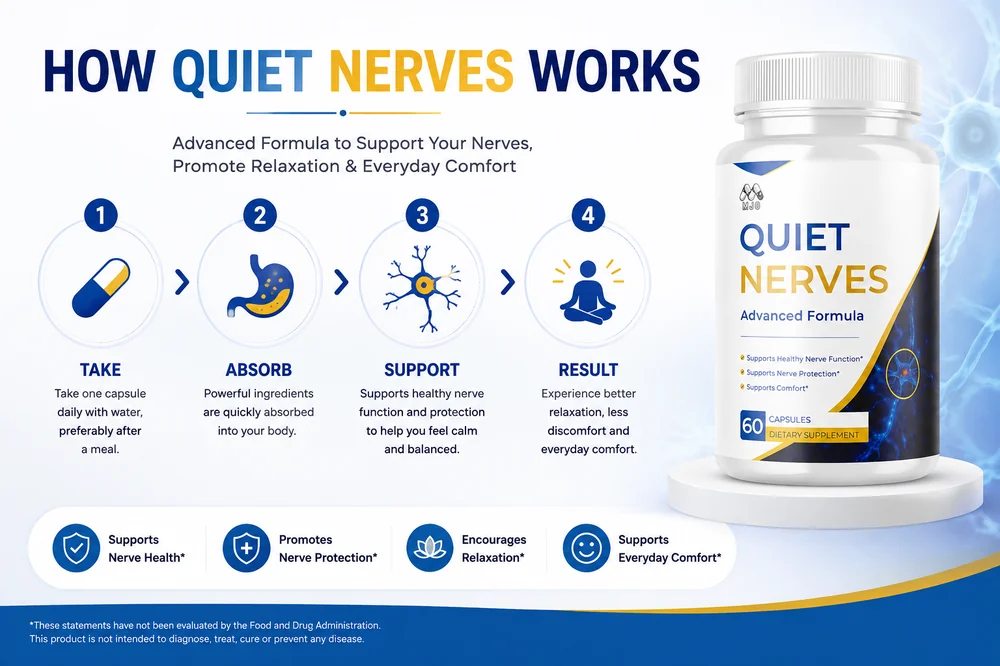
One capsule each day with water, after a meal. No powders, no timing, no stacking. Adherence is the variable that beats every other one, and that is well supported by the behaviour-change literature: a modest routine sustained for months outperforms an elaborate one abandoned in week two.
It matters especially here, because the seller's own framing asks for several weeks of consistent use before judging. A regimen you cannot sustain for that long cannot be evaluated at all.
Where this leaves the product is honest enough: a convenient daily habit built from six sensible, well-chosen ingredients, whose effect size cannot be estimated because the amounts are not published. Whether that is worth $49 a bottle is a judgement only you can make — but it should be made with that gap in view, and after the blood sugar conversation if it applies to you.
A benefits page listing only benefits is an advertisement.
The seller states this plainly and it is repeated here without softening: Quiet Nerves is a dietary supplement, not a treatment for neuropathy, diagnosed nerve damage or any other medical condition.
Persistent tingling, numbness, burning or nerve pain needs a diagnosis, not a capsule. Those symptoms have identifiable and often treatable causes — diabetes and prediabetes, vitamin B12 deficiency, thyroid disease, nerve compression, alcohol-related nerve damage, certain medications including some chemotherapy agents, and autoimmune conditions among them. Several of those get worse while untreated, and some are reversible if caught early.
B12 deficiency is worth singling out because it is common, it produces exactly these symptoms, it is diagnosed with a simple blood test, and untreated it can cause permanent nerve damage. It is also cheap to correct. No nerve-support supplement substitutes for that test.
The reference says something very similar in its own FAQ — that anyone with persistent symptoms should see a qualified healthcare professional rather than rely on a supplement alone. That is the right advice, and taking it seriously matters more than any purchasing decision on this website.
Credit first: the seller tells you this itself. Its own wording is that all six ingredients are named but exact per-capsule amounts are not published, and that this is the honest context for setting expectations. Volunteering that is rare in this category and it should count in the product's favour.
It remains the central gap, though, because naming an ingredient tells you what is in the bottle while only an amount tells you whether there is enough of it to matter.
Why this matters arithmetically. A standard capsule holds roughly 500–800 mg of material in total. Alpha lipoic acid alone, at the amounts used in nerve research, would fill most of one. Add a nutritionally meaningful amount of magnesium, plus CoQ10, plus gram-scale L-carnitine, and the studied amounts run to several grams a day. Six ingredients cannot all appear at research levels in a single capsule — there is not physically room. That is true of every six-ingredient single-capsule formula, and it is precisely why the amounts should be published.
The one question worth asking the seller before you buy is the milligram amount of each ingredient per capsule. It would be a single line to answer, and for alpha lipoic acid it is a safety question as much as a value one.
This is the single most practical thing on this website, and the seller deserves credit for raising it unprompted rather than burying it.
Alpha Lipoic Acid can lower blood sugar. That is a documented property, not a theoretical concern. It is also part of why the ingredient is of interest in the first place.
If you take insulin, sulfonylureas, or any other medication that lowers blood glucose, adding something else that also lowers it can push your levels too far down. Hypoglycaemia is not a minor inconvenience — it can cause shaking, confusion, loss of consciousness and, at the extreme, is a medical emergency.
What to do: speak to your doctor or pharmacist before you start, not after. Bring the actual bottle or the ingredient list. If you are given the go-ahead, keep monitoring your blood glucose exactly as you already do, and know how to recognise and treat a low.
There is a second reason this matters here specifically. The per-capsule amount of alpha lipoic acid is not published, so neither you nor your doctor can see how much you would be taking. That does not make the conversation impossible, but it does make it more important — and it is a fair question to put to the seller before you buy.
Two groups where this deserves particular attention: anyone managing diabetes, and anyone with a history of low blood sugar episodes. If that is you, this is a doctor's-appointment decision rather than a shopping decision.
The studies referred to here examined individual ingredients on their own, at the amounts the researchers chose — typically hundreds of milligrams a day, and for L-carnitine, grams.
That research explains why an ingredient is of interest. It does not show that Quiet Nerves reproduces those results. No clinical trial of this finished formula has been published, and because no per-capsule amount is published, the comparison cannot be completed from the outside. Nothing on this site estimates the missing figures.
The reference makes this same point about its own citations, noting that they concern the individual ingredients rather than the finished product. That is an accurate and unusually careful thing for a sales page to say.
The seller says regular activity supports the circulation this formula is designed to complement, not replace. That is a fair statement and worth expanding.
Movement is the most direct lever on circulation to the hands and feet, and walking counts. Blood sugar control matters enormously for nerve health, because sustained high glucose is among the most common causes of nerve damage worldwide — which is why the diabetes question runs through this whole site. B12 and other nutrient adequacy is measurable and correctable. Alcohol is directly toxic to nerves in quantity. Not smoking matters for the same circulatory reason. Well-fitting footwear and foot checks are unglamorous and genuinely protective if you have any diagnosed nerve issue.
Quiet Nerves is positioned to sit alongside those things. It is not a substitute for any of them, and the ones above are free.
The three packages the seller currently lists. Every figure below is theirs, and the arithmetic checks out on all of them.
$138 total, plus shipping
No struck-through price published for this tier
$474 → $294 total
Seller states a saving of $180
$237 → $177 total
Seller states a saving of $60
Arithmetic verified. $69×2=$138, $59×3=$177 and $49×6=$294. The stated regular price of $79 a bottle agrees with both struck-through totals exactly ($79×3=$237, $79×6=$474), and the advertised $180 saving on the six-bottle package is exactly $474−$294. That internal consistency is worth noting, because it is not the norm in this category. Note that free shipping applies only to the three- and six-bottle packages — the two-bottle tier is listed as plus shipping, and no shipping cost is published. These are current listed offers rather than permanent prices; the official checkout is the only authoritative source.
The seller states a 60-day money-back guarantee running from the date of purchase, arranged through customer support, with no subscription, no automatic renewals and no rebills — a one-time payment for what is in your cart.
The seller says nutritional support of this kind is gradual and should be judged over several weeks of consistent use rather than days. That is an honest statement, and a 60-day window is long enough to act on it — which is not always true of guarantees in this category.
The tension is with package size rather than with the window itself. A two-bottle order is a 60-day supply and matches the guarantee exactly, while the six-bottle order runs 180 days — three times longer than your right to a refund. If you buy six, diarise day 60 and make the call then.
Two things the published terms do not settle: who pays return postage and whether opened bottles can be returned. Both are worth confirming with support before ordering.
The no-subscription commitment is genuinely worth having in a category where negative-option billing is common. Keep your order confirmation and note your deadline.
Read the alpha lipoic acid page first. It is the most interesting ingredient in the formula and the one with a real medication interaction attached — and if you take anything for blood sugar, that conversation matters more than any purchase decision.
From $49 per bottle · 60-day money-back guarantee · No subscription or rebills